

Tithi · lunar day
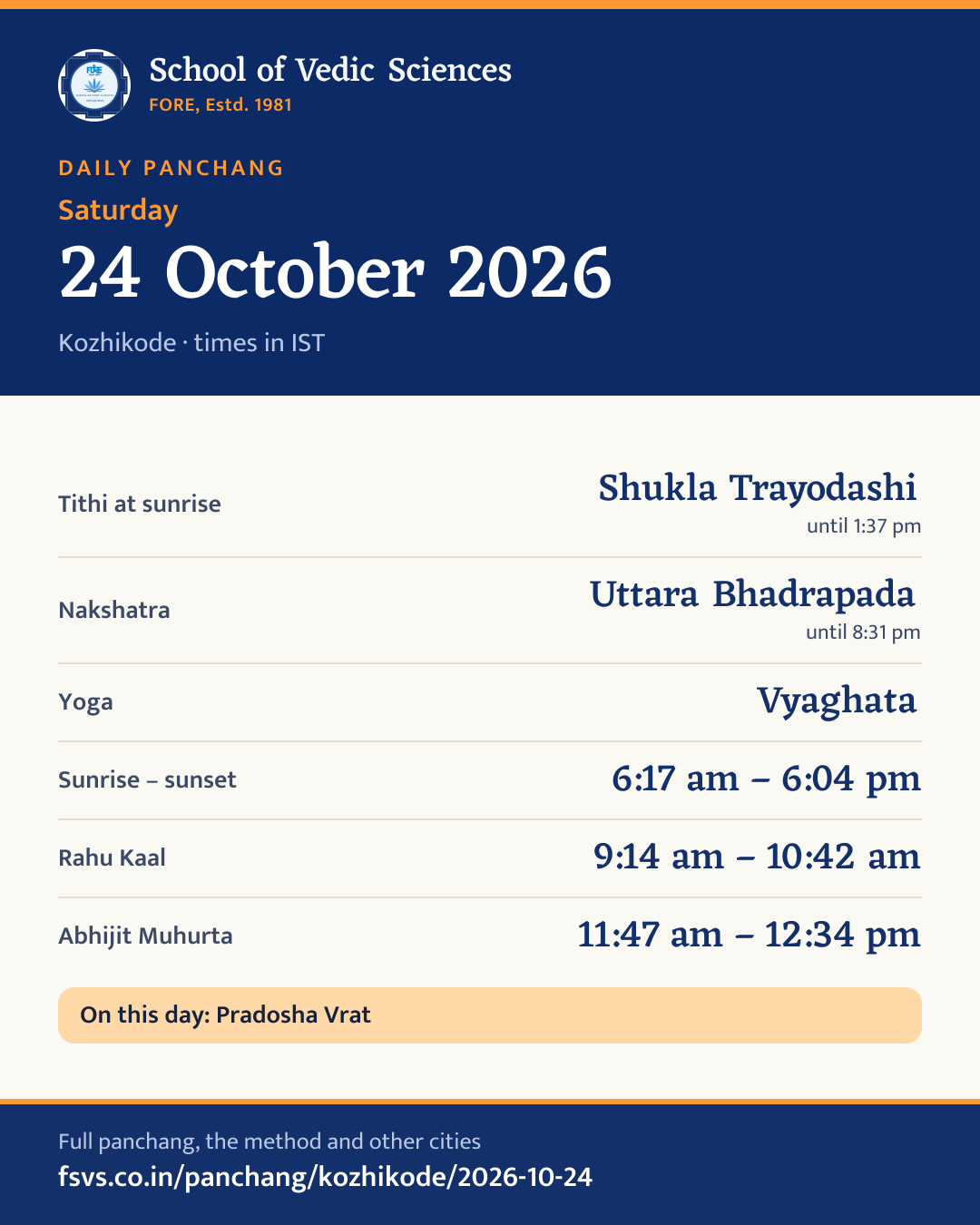
Shukla TrayodashiThe thirteenth day of the bright half
Pradosh evening.
Until 1:37 pm
- Then Shukla Chaturdashi (the fourteenth day of the bright half) from 1:37 pm
Panchang · Kozhikode · Saturday, 24 October 2026
The Moon passes from Uttara Bhadrapada into Revati nakshatra at 8:31 pm; the Sun is in Tula.
It is Sharad ritu (autumn), in Dakshinayana, the Sun’s southward half-year.
Panchang means “five limbs”. Each is named by what is running at sunrise.
Tithi · lunar day
Pradosh evening.
Until 1:37 pm
Nakshatra · the Moon’s star
The latter blessed feet, in Meena (Pisces).
Until 8:31 pm
Yoga · Sun–Moon combination
Until 8:00 pm
Karana · half a tithi
Until 1:37 pm
Vara · weekday
From sunrise to the next sunrise (6:17 am on 25 Oct)
The day lasts 11 hr 48 min and the night 12 hr 12 min. All times are Indian Standard Time for Kozhikode.
Green periods are counted good for beginnings, red ones are avoided, blue is neutral. Times are for the city chosen above.
Choghadiya
Muhurta and kaal
Tap any segment to see its name and time here.
Brahma Muhurta
4:41 am – 5:29 am · 48 min
The 48 minutes that end 48 minutes before sunrise, traditionally kept for study, prayer and meditation
Abhijit Muhurta
11:47 am – 12:34 pm · 47 min
The eighth of the fifteen daytime muhurtas, centred on local noon; held to be strong for beginning important work
Rahu Kaal
9:14 am – 10:42 am · 1 hr 28 min
The eighth part of the daylight ruled by Rahu; almanacs advise against beginning new work in it
Gulika Kaal
6:17 am – 7:45 am · 1 hr 28 min
The part of the daylight ruled by Gulika, Shani’s son; what begins in it is said to repeat, so it is avoided for good beginnings
Yamaganda
1:39 pm – 3:07 pm · 1 hr 28 min
The part of the daylight ruled by Yama; avoided for auspicious beginnings
Day and night are each cut into eight parts; each part takes one of seven names in a fixed cycle that begins with the weekday’s ruler.
Kaal“loss” · avoid6:17 am – 7:45 am
Avoided for beginnings; said to suit routine and repair work
Shubh“auspicious” · good7:45 am – 9:14 am
Good, especially for ceremonies and study
Rog“affliction” · avoid9:14 am – 10:42 am
Avoided for beginnings and travel
Udveg“anxiety” · avoid10:42 am – 12:11 pm
Unsettled; avoided for beginnings, though used for government work
Char“moving” · neutral12:11 pm – 1:39 pm
Neutral; favoured for travel and anything that moves
Labh“gain” · good1:39 pm – 3:07 pm
Good for business, learning and new ventures
Amrit“nectar” · good3:07 pm – 4:36 pm
The best of the seven; almanacs count it good for any work
Kaal“loss” · avoid4:36 pm – 6:04 pm
Avoided for beginnings; said to suit routine and repair work
Labh“gain” · good6:04 pm – 7:36 pm
Good for business, learning and new ventures
Udveg“anxiety” · avoid7:36 pm – 9:08 pm
Unsettled; avoided for beginnings, though used for government work
Shubh“auspicious” · good9:08 pm – 10:39 pm
Good, especially for ceremonies and study
Amrit“nectar” · good10:39 pm – 12:11 am on 25 Oct
The best of the seven; almanacs count it good for any work
Char“moving” · neutral12:11 am on 25 Oct – 1:42 am on 25 Oct
Neutral; favoured for travel and anything that moves
Rog“affliction” · avoid1:42 am on 25 Oct – 3:14 am on 25 Oct
Avoided for beginnings and travel
Kaal“loss” · avoid3:14 am on 25 Oct – 4:45 am on 25 Oct
Avoided for beginnings; said to suit routine and repair work
Labh“gain” · good4:45 am on 25 Oct – 6:17 am on 25 Oct
Good for business, learning and new ventures
Twelve horas by day and twelve by night, each ruled by one graha. The first hora after sunrise belongs to the lord of the weekday.
A panchang (panch-anga, 'five limbs') is the traditional Indian almanac. For each day it records five elements: tithi (lunar day), nakshatra (the Moon's asterism), yoga (a Sun–Moon sum), karana (half-tithi) and vara (weekday). All five are computed from the positions of the Sun and Moon for a given place, which is why a panchang is always tied to a location and a sunrise. Festivals, fasts and muhurtas are read from these elements rather than from the civil date.
A tithi is the time the Moon takes to move 12° further from the Sun in longitude. Thirty tithis make a lunar month: fifteen in the bright half from new moon to full, and fifteen in the dark half back to new moon. Because the Moon's speed varies, a tithi lasts anywhere from about 19 to 26 hours and rarely lines up with a civil day. The tithi running at sunrise is the one written against that day in the panchang, though many observances use the tithi at another time, such as midnight or moonrise.
The nakshatras are 27 equal divisions of the sidereal zodiac, each 13°20' wide, named after star groups along the Moon's path. The Moon passes through one nakshatra in roughly a day, so the panchang names the nakshatra the Moon occupies at sunrise. Each has a traditional symbol, deity and planetary lord, and is classed by temperament (fixed, movable, soft, sharp and so on) for choosing muhurtas. Some festivals are fixed by nakshatra rather than tithi, Onam being a familiar example.
Here yoga is not a planetary combination but a panchang element: the sum of the Sun's and Moon's sidereal longitudes, divided into 27 equal parts of 13°20'. The 27 yogas run from Vishkambha to Vaidhriti and each carries a traditional quality, auspicious, inauspicious or mixed. Vyatipata and Vaidhriti are also treated as parva days for charity and recitation. A yoga changes at a time that depends only on the combined motion of the two lights, so it is independent of tithi and nakshatra.
A karana is half a tithi, 6° of Moon–Sun separation, so there are 60 karanas in a lunar month. Only eleven names are used: seven movable ones (Bava to Vishti) that repeat eight times each, and four fixed ones (Shakuni, Chatushpada, Naga, Kimstughna) that occupy the four half-tithis around the new moon. The panchang usually lists the karana at sunrise and the one that follows. Vishti, better known as Bhadra, is the karana most people look for, since festival timings are chosen to avoid it.
Vara is the weekday, counted from sunrise to the next sunrise rather than from midnight. The seven varas take their names from the Sun, Moon, Mars, Mercury, Jupiter, Venus and Saturn, in the same order as the Western week. Each vara has a traditional lord and a set of observances, such as Somvar fasts for Shiva or Shanivar for Shani. Because the day begins at sunrise, an event before dawn belongs, in panchang terms, to the previous vara.
A paksha is a lunar fortnight of fifteen tithis. Shukla paksha, the bright half, runs from the new moon to the full moon as the Moon waxes; Krishna paksha, the dark half, runs from the full moon back to the new moon as it wanes. Tithi names repeat in each paksha, so a date is only complete when the paksha is stated, as in 'Shravana Krishna Ashtami'. Many observances belong to one paksha only: Vinayaka Chaturthi to Shukla, Sankashti to Krishna.
Indian lunar months are counted in two ways. In the amanta system, used in Maharashtra, Gujarat, the South and in this engine, a month runs from new moon to new moon and the bright half comes first. In the purnimanta system of North India, a month runs from full moon to full moon, so the dark half comes first and carries the name of the following amanta month. The two systems agree on every bright-half date and differ only in the name given to the dark half; Janmashtami is Shravana Krishna 8 in amanta and Bhadrapada Krishna 8 in purnimanta, on the same night.
Twelve lunar months fall about eleven days short of a solar year, so roughly every 32 months an extra month is inserted to keep festivals in their seasons. A lunar month that contains no sankranti (the Sun's entry into a new rasi) is declared adhika, 'extra', and takes the name of the month that follows with the prefix adhika; the regular month is then called nija or shuddha. Festivals are kept in the nija month, not the adhika one. Rarely, a month holds two sankrantis and is dropped as a kshaya masa.
Two eras are commonly printed on a panchang. Vikram samvat, used across North and West India, is ahead of the Gregorian year by 57 (56 before the new year); it begins on Chaitra Shukla Pratipada in the north and on Kartika Shukla Pratipada in Gujarat. Shaka samvat, behind the Gregorian year by 78, is the civil era adopted by the Government of India in 1957 and the one used in the South and in Maharashtra. Both are lunisolar reckonings; the Gregorian date on which a new samvat begins moves each year with the lunar calendar.
Ayana is the half-year defined by the Sun's direction of travel: Uttarayana, when it moves north, begins at Makara sankranti, and Dakshinayana, when it moves south, begins at Karka sankranti. In the sidereal reckoning these fall around 14 January and 16 July, some three weeks after the solstices, because of the ayanamsa. Each ayana holds three ritus, or seasons, of two months each: Vasanta, Grishma and Varsha in the first half, Sharad, Hemanta and Shishira in the second. The lunar months are paired with the ritus, which is one reason the adhika masa is needed.
The daytime between sunrise and sunset is divided into eight equal parts, and three of them are named after shadowy planets. Rahu Kaal falls in a different eighth on each weekday (the eighth, second, seventh, fifth, sixth, fourth and third parts from Sunday to Saturday); Gulika and Yamaganda follow their own weekday sequences. Each lasts about an hour and a half near the equinoxes, and longer or shorter as the day lengthens or shortens. These are local times and must be computed from the sunrise of the place in question; muhurta texts set them aside for beginnings, while routine work continues.
Abhijit is the eighth of the fifteen muhurtas of the day, centred on local apparent noon. It lasts two ghatis, about 48 minutes, running roughly 24 minutes either side of midday as measured from the actual sunrise and sunset of the place. Tradition treats it as a generally usable window on most days, with Wednesday commonly excepted. It shares its name with a 28th nakshatra, a short segment within Uttara Ashadha and Shravana, used in some older schemes.
Brahma muhurta is the second-last muhurta of the night, the window of two ghatis (about 48 minutes) that ends 48 minutes before sunrise. In a place where the Sun rises at 6:00, it runs from about 4:24 to 5:12, and it shifts with the seasons and the location. The texts associate it with study, recitation and quiet work before the day begins. Because it is tied to sunrise, it is not a fixed clock time.
Choghadiya ('four ghadis', about 96 minutes) divides the day and the night into eight parts each. Every part is assigned one of seven names, Udveg, Char, Labh, Amrit, Kaal, Shubh and Rog, in a sequence that starts from the weekday lord and cycles through the planetary order. Amrit, Shubh, Labh and Char are traditionally treated as usable, the rest set aside. The system is popular in Gujarat and Rajasthan and depends on local sunrise and sunset.
A hora is one twenty-fourth of the day, twelve from sunrise to sunset and twelve from sunset to sunrise, each stretched or shortened with the season. The first hora of the day belongs to the weekday lord, and the rest follow the planetary order Sun, Venus, Mercury, Moon, Saturn, Jupiter, Mars, repeating. This is the same scheme that gave the weekdays their names, since the 25th hora of each day falls to the next planet in the sequence. Panchangs list the hora lord as one of the finer muhurta divisions.
Ayanamsa is the angle between the tropical zodiac, which starts at the vernal equinox, and the sidereal zodiac, which is fixed against the stars. The equinox drifts backwards about 50 arc-seconds a year, so the gap grows slowly; today it is a little over 24°. The Lahiri ayanamsa, adopted by the Calendar Reform Committee in 1956 and used by Indian government ephemerides, fixes the zero point so that Spica (Chitra) sits at 180°. This engine uses Lahiri, which is why its nakshatra and sankranti timings match the Rashtriya Panchang and most published Indian almanacs.
In the panchang a day begins at local sunrise, not at midnight. The tithi, nakshatra, yoga and karana written against a date are the ones running at that sunrise, and the weekday itself changes at sunrise. This is why the same date can show different tithis in Delhi and Chennai when a tithi ends between their sunrises, and why a panchang must be computed for a place. Observances that depend on another moment, such as midnight for Janmashtami or moonrise for Karwa Chauth, say so explicitly; sunrise is the default.
Because a tithi can be shorter or longer than a day, the sunrise-to-sunrise rule produces two irregularities. A kshaya (lost) tithi begins after one sunrise and ends before the next, so it never touches a sunrise and is skipped in the day count; the calendar then jumps, for example, from the 6th to the 8th. A vriddhi (grown) tithi spans two sunrises and is written against two consecutive days. Neither is an error; they are the ordinary result of fitting roughly 29.5 tithis into 29 or 30 civil days, and festival rules say which of the two days to take.
Panchak is the stretch of about five days each month when the Moon passes through the last five nakshatras, from Dhanishtha (second half) through Shatabhisha, Purva Bhadrapada and Uttara Bhadrapada to Revati, that is, from the middle of Kumbha to the end of Meena. Muhurta texts set these days aside for a specific list of activities, chiefly those involving the southern direction, roofing, bedding and cremation rites, for which particular observances are prescribed. Everyday work, travel and most ceremonies are not affected. A panchang marks the start and end to the minute, since the Moon's entry into Dhanishtha's second half is a computed moment.
Bhadra is the common name for the Vishti karana, which occurs eight times a month: in the second half of Shukla 4, 11 and Krishna 3, 10, and in the first half of Shukla 8, 15 and Krishna 7, 14. Tradition places Bhadra in one of three worlds depending on the Moon's rasi, and only the Bhadra 'on earth' (Moon in Karka, Simha, Kumbha or Meena) is treated as needing to be avoided. Raksha Bandhan and Holika Dahan timings are published specifically to fall outside Bhadra. Like every karana, it begins and ends at computed moments that do not depend on the clock date.
More from the Panchang